
Hi, I'm Ivan Novak from Indiana. When Craig "The Water Guy" Phillips reached out asking me to share my journey with the SoftPro ECO™ City Water Softener - Best Water Softener Systems for City Water, I figured my story might help other homeowners facing similar water challenges. Here's exactly how everything unfolded for me, and I genuinely hope it guides your decision-making process.
The Hard Water Nightmare That Started It All
Living in Indiana, I thought I'd seen it all when it came to water issues, but nothing prepared me for what we discovered after moving into our current home three years ago. The telltale signs started subtly – a slight film on our glassware that wouldn't come off no matter how much I scrubbed, and my wife constantly complaining about her hair feeling "weird" after showers.
But the real wake-up call came when our brand-new dishwasher started showing white, chalky buildup on the heating element after just six months. I'm talking about a $800 appliance that looked like it had been running for a decade. The calcium and magnesium deposits were so thick, I could literally scrape them off with my fingernail.
What was causing this destruction?
Our municipal water supply was delivering a whopping 18 grains per gallon of hardness – that's considered "very hard" by any standard. To put that in perspective, anything above 10.5 grains per gallon starts causing serious problems for households. The dissolved minerals were essentially turning our water into a slow-acting appliance killer.

The financial impact became crystal clear when our water heater efficiency dropped dramatically. Our energy bills spiked by nearly $40 per month because mineral scale was insulating the heating elements, forcing them to work overtime. I calculated that we were looking at potentially thousands in premature appliance replacement costs if we didn't address this issue immediately.
My Research Journey Into Water Softening Solutions
I'll admit, I initially tried the "cheap fix" route. We installed a basic shower filter and started using expensive rinse aids in the dishwasher. For about two months, I convinced myself these band-aid solutions were working. They weren't.
That's when I dove deep into understanding water softening technology. I spent weeks researching ion exchange systems, reading about resin beds, and trying to understand the difference between salt-based and salt-free systems. The more I learned, the more I realized we needed a comprehensive solution, not just another temporary fix.
The key factors in my decision-making process were: • Capacity to handle our household of four with high water usage • Efficiency in salt and water consumption during regeneration cycles • Space requirements (our utility room is pretty cramped) • Long-term operational costs versus initial investment • Warranty coverage and manufacturer reputation
Why did salt-based systems keep rising to the top?
After comparing technologies, I learned that salt-free systems don't actually remove hardness minerals – they just change their structure to reduce scaling. For our severe hardness level, only true ion exchange technology would eliminate the calcium and magnesium ions causing our problems.
Why I Chose the SoftPro ECO Over Other Options
The SoftPro ECO stood out for several technical reasons that directly addressed our specific situation. First, its upflow regeneration design caught my attention because it uses significantly less water and salt compared to traditional downflow systems. We're talking about 50% less waste water per regeneration cycle.
The digital metered control head was another deciding factor. Instead of regenerating on a timer regardless of actual water usage, this system tracks our consumption and only regenerates when necessary. For a family that travels frequently, this efficiency feature alone justified the investment.
But what really sold me was the system's best water softener capacity rating. The ECO handles up to 64,000 grains of hardness removal between regenerations, which translates to about 8-10 days for our household usage patterns. The math worked perfectly for our 18 GPG hardness level and typical consumption of 280 gallons per day.
How did the warranty compare to competitors?
SoftPro offers a 10-year warranty on the control valve and a lifetime warranty on the mineral tank. Most competitors were offering 5-7 years maximum. Given that this is a significant investment, the extended warranty coverage provided crucial peace of mind.
Unboxing and Initial Setup Experience

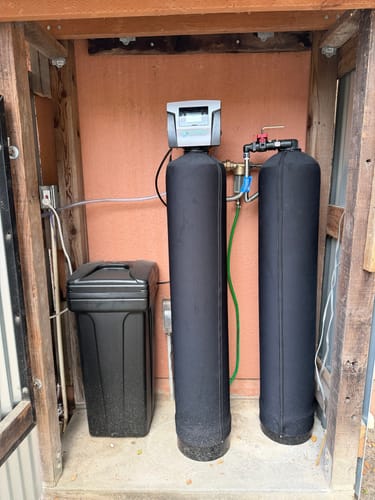
When the SoftPro ECO arrived, I was immediately impressed by the packaging quality. Everything was securely wrapped and protected, with clear labeling for each component. The mineral tank is substantial – we're talking about a 10" x 54" fiberglass vessel that definitely requires two people to move safely.
The control head arrived pre-programmed with standard settings, but I appreciated that all the configuration options were clearly explained in the installation manual. Speaking of the manual, it's actually readable – detailed enough for serious DIYers but not overwhelming with unnecessary technical jargon.
What surprised me was the quality of the bypass valve included in the kit. It's a genuine Fleck valve, not some generic knockoff. The brass fittings and stainless steel components immediately communicated that this wasn't a budget system with corners cut on important details.
Installation Process and First Challenges
I decided to tackle the installation myself, partly to save the $300 installation fee and partly because I enjoy these types of projects. The whole process took me about 4 hours, including time to carefully review each step.
The trickiest part was getting the positioning right in our utility room. The system needs adequate clearance for the control head and access for salt loading, plus you need to account for the drain line routing. I ended up having to rearrange some shelving to create proper workspace.
Plumbing the bypass valve into our main water line required cutting the copper pipe and installing new fittings. If you're not comfortable with basic plumbing, this step alone justifies hiring a professional. The system connects with standard 1" NPT fittings, and everything lined up perfectly once I had the measurements correct.
What would I do differently during installation?
I should have tested the system thoroughly before putting everything back together. During my initial startup, I discovered a minor leak at one of the union connections that required retightening. It wasn't a design flaw – just my own rushed assembly.
The control head programming was straightforward once I understood the menu system. You input your water hardness level, iron content (if any), and household size. The system calculates optimal regeneration timing automatically. I set ours for 18 GPG hardness with a capacity setting for 4 people, and it's been running flawlessly ever since.
Real-World Performance After Six Months of Use
The transformation in our water quality was noticeable within 24 hours of installation. The first shower felt completely different – soap actually lathered properly, and that sticky feeling on our skin disappeared entirely. My wife noticed her hair was softer and more manageable immediately.
But the real proof came in our appliances' performance. Our dishwasher started producing spotless glassware again, and the white film on our shower doors stopped forming. I tested the outgoing water hardness with test strips, and we're consistently getting 0-1 grains per gallon – essentially perfect soft water.
The system regenerates every 8-9 days based on our actual usage patterns, consuming approximately 6 pounds of salt per cycle. At current salt prices, that translates to about $8-10 per month in operating costs. Compared to our previous $40 monthly increase in energy bills, the ROI is substantial.
Have there been any performance surprises?
One unexpected benefit was the improvement in our laundry results. Clothes are noticeably softer, and we've reduced our detergent usage by about 30% while achieving better cleaning results. The soft water allows soap to work more efficiently, creating better suds with less product.
I've also noticed that our water heater is running more efficiently. The heating elements are no longer fighting through mineral scale buildup, and our energy bills have returned to normal levels. That monthly $40 savings alone helps offset the system's operational costs.
Maintenance Requirements and Long-Term Ownership
Maintaining the SoftPro ECO has been refreshingly simple. The primary requirement is keeping the brine tank filled with salt, which I do every 4-6 weeks depending on our usage. The system alerts you when salt levels are low, so you're never guessing about timing.
Every three months, I clean the brine tank to prevent salt bridging – basically making sure the salt dissolves properly and doesn't form a hard crust. This takes about 15 minutes and just involves stirring the salt and checking for any buildup around the edges.
The control head displays useful diagnostic information, including total gallons processed, days since last regeneration, and current system status. I appreciate having this data because it helps me understand our usage patterns and verify everything is operating normally.
What about long-term component replacement?
The resin bed should last 10-15 years with proper maintenance, according to the manufacturer specifications. Given the quality of our input water and the system's efficient regeneration cycle, I'm confident we'll reach the upper end of that range.

The only consumable beyond salt is the occasional sanitizing treatment, which I perform annually using a basic bleach solution. The process is clearly outlined in the manual and takes about 30 minutes total.
Final Assessment and Buying Recommendation
After six months of daily use, the SoftPro ECO has exceeded my expectations in every measurable way. Our water quality problem is completely solved, our appliances are protected, and the operational costs are exactly as projected. The initial investment of $1,200 has already started paying dividends through reduced energy bills and eliminated appliance damage.
This system is ideal for households dealing with moderate to severe hardness levels who want a set-and-forget solution. The metered regeneration and upflow design make it particularly efficient for families with variable water usage patterns.
Would I recommend this to other homeowners?
Absolutely, especially if you're dealing with hardness levels above 10 grains per gallon and want proven ion exchange technology. The build quality, warranty coverage, and performance consistency justify the investment for serious water quality improvement.
However, if you're on a tight budget or dealing with minimal hardness issues, you might consider starting with basic water testing and exploring less expensive alternatives first. This is a premium solution for households ready to make a long-term commitment to water quality.
For our situation in Indiana with severely hard municipal water, the SoftPro ECO was exactly the right choice. It's solved our problems completely and should continue protecting our home's plumbing and appliances for many years to come.